Calendario
Sbobine.
Managing shifts for 100, 200, or 400 students with WhatsApp, scattered sheets, and Excel means losing hours every week. With Calendario Sbobine, coordination becomes automatic. The administrator uploads the calendar and users. The system imports lessons, generates shifts fairly, manages unavailabilities and swaps, and automatically updates everyone.
The problem wasn't creating shifts. It was managing everything that happens after.
In university programs, managing transcription shifts means chasing down dozens or hundreds of people, handling absences, shift changes, illnesses, internships, work, and constant last-minute exceptions.
Most of the time was spent on WhatsApp: messages, corrections, swaps to coordinate by hand, people to remind, and calendars to redo every time.
The real limitation was this: the system had to be simple to use, immediately accessible, and reliable under load, able to handle a large group without becoming another administrative burden.
You upload the data. The system organizes the rest.
Access is simple via Google, but only for users authorized by the administrator. Once the calendar and members are uploaded, the system automatically imports the lessons and generates shifts based on fairness criteria.
Every user can see their own shifts, report unavailability, request swaps, and confirm they have viewed the schedule. The administrator maintains complete control: they see activities, confirmations, notifications sent, and modifications requested.
The app is a web app installable as a PWA, so it can be used like a normal app with push notifications, or with email notifications.
From shift import to accepted swap.
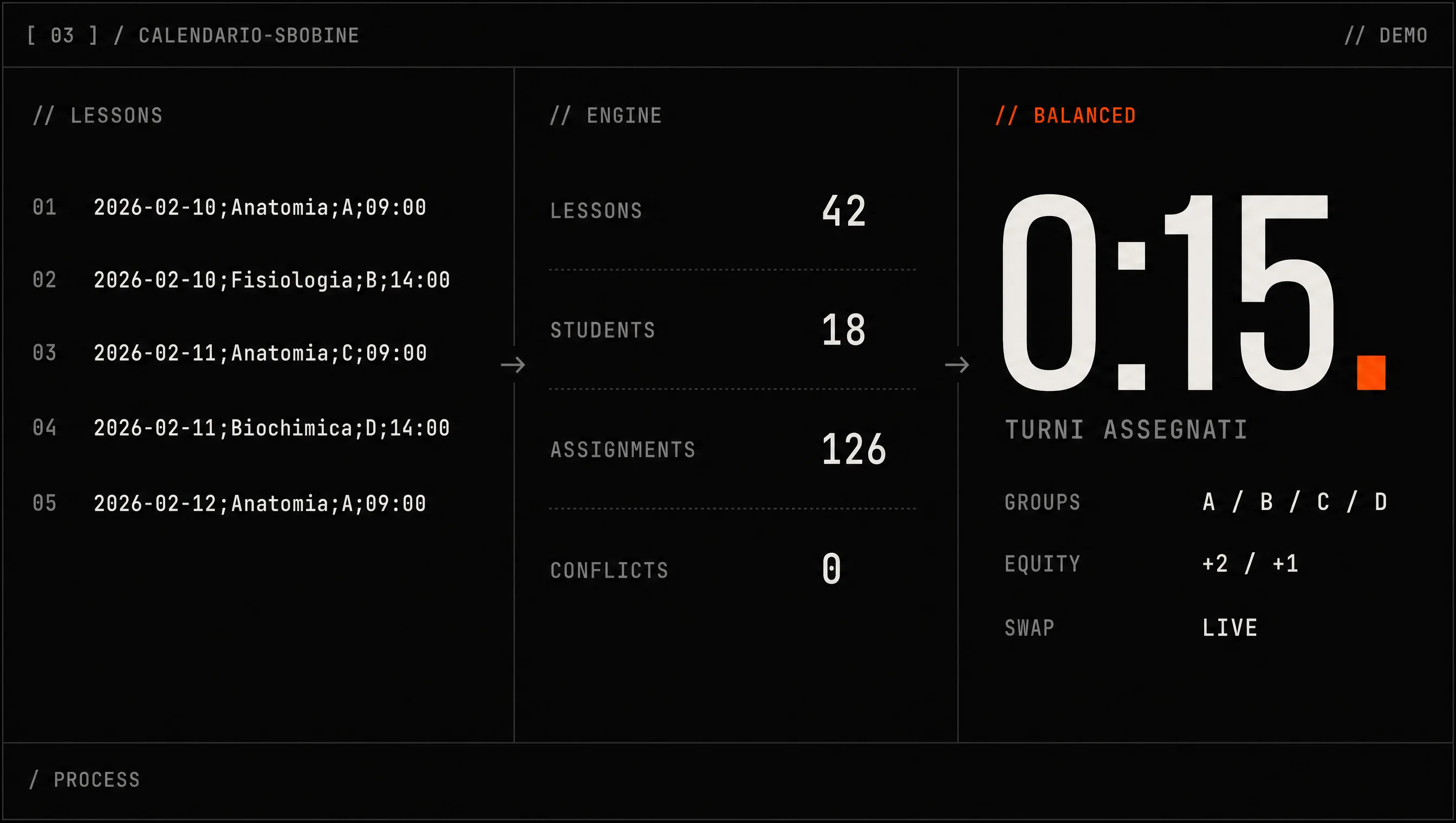
→ From the schedule file to everyone's iPhone calendar, in 15 seconds.
Less time lost, fewer messages, more control.
What used to require hours of manual coordination is today managed in a single system: automatically assigned shifts, orderly swaps, tracked unavailabilities, and centralized notifications.
The result is simple: less operational chaos, less time spent chasing people, and shift management that is finally sustainable even with large numbers.
Have a coordination problem to automate?
Fairness algorithms, autonomous swaps, file import. Let's talk about your specific case.